

In every essay I have written here, I have approached the question of dharmic management from one direction — the leader. How to shape oneself. How to choose sreyas over preyas. How to master oneself before attempting to lead others. How to keep one’s perspective when handed power. The premise underneath all of it has been that if the person at the top embodies dharmic values — sustainability, service to all stakeholders, ethical action — then the institution they build will reflect those values too.
These are all necessary, but this premise is incomplete.
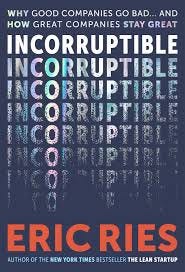
Eric Ries’s new book, Incorruptible: Why Good Companies Go Bad… And How Great Companies Stay Great, has clarified for me what I had been circling but not quite naming. There is a force acting on every company that pulls it, slowly and relentlessly, away from the values its founders may have begun with. Eric calls it financial gravity. It does not require bad actors, though they frequently excuse their own actions with it. It mostly operates the way gravity does — quietly, in every interaction, in every meeting, in every decision about whose interests to weigh. And like gravity, over a long enough horizon, it wins — unless we build specifically to resist it.
I had been thinking about outlining how to build a dharmic company. But after reading Eric’s book, I ended up writing a book review. Eric wrote the first angel check that was not from family or friends into my first company, Molekule. But as big as that was for my career and the company, I’d always credit him for his contributions of knowledge foremost. I, like so many founders, learned much about how to build a company from The Lean Startup, which Eric wrote and which reshaped how a generation of founders thinks about iteration and learning. Years later I met him again as he was building LTSE, the Long Term Stock Exchange. His framing of the problem there — that public markets had become structurally hostile to long-term thinking — directly shaped the language I use today when I talk about prioritizing quarters and shareholders rather than decades and stakeholders.
I believe Incorruptible is his most important book to date.
What does it mean for a company to be ‘dharmic’?
In the very first essay on this Substack, I introduced the definition of dharma as I understood it: dharyate iti dharma: “that which sustains is dharma.” I described how I had come to relate it to the cycles of boom and bust in business and the economy:
“It was then that I began thinking more deeply of the concepts I had grown up with — the meaning of Dharma: ‘dharyate iti dharma’ ‘that which sustains is dharma’ — and I began to relate it to business and economic cycles of boom and bust. These cycles stem from short-term & narrow thinking. Prioritizing quarters and shareholders rather than decades and stakeholders. The accumulated cost of these decisions over time drives the economic boom and bust cycles of expansion and recession. This lack of sustainability is not just economic, but environmental as well.”
A dharmic company, at its simplest, is one that sustainably generates benefit for everyone it touches — customers, employees, suppliers, the communities it operates in, and the natural world it draws from — and does so in an ethical way. Not one or the other. Not customers at the expense of employees, not employees at the expense of the planet, not the planet at the expense of solvency. Sustainability across all of them, in the long run, not quarters.
Dharmic traditions have long understood this. The four puruṣhārthas — dharma, artha, kāma, mokṣa — are listed in that order on purpose. Artha (material success, wealth) and kāma (desire, ambition) are legitimate human pursuits, but without dharma they become corrosive. The Vedic mind grasped, well before modern economics, that wealth unconstrained by righteousness does not stay wealth for long. It eats the conditions that made it possible.
Thus, if leaders themselves are dharmic — if they choose sreyas over preyas, if they have done the inner work that lets them hold power without being corrupted by it — then artha in their hands will remain bounded.
But only so long as they lead.
What Eric documents in Incorruptible is that the idea of building an enlightened company is not new. Founders have tried it again and again, across centuries. There is a long graveyard of such companies. They were not really destroyed by competition, in fact building this way seems to be more successful than average. Most were destroyed by something subtler: the slow conversion of the company itself, from inside, into something its founders would not have recognized.
The mechanism is what Eric names Financial Gravity. It is the unspoken force that transforms every interaction inside a company. It comes across as a ‘best practice’ or simply how business is done. In reality it is the extraction of value from any source that can be transferred to shareholders. It might not be a nefarious action of a powerful leader. It may be as simple as an employee of a public company watching the stock ticker, and internalizing what the market punishes and rewards.
The consequence, as Eric illustrates through a remarkable range of stories — both from history and from the modern day — is corruption. The gradual decay of a thing’s nature into something other than itself. And alongside that decay there is a steady human cost — the employees who tried to hold the original line and were quietly pushed out, the customers who came to be treated as marks rather than served, the founders themselves who one day looked up and found that the company they were leading was no longer the one they had built.
If the only defense against this is the personal integrity of the leader, then the leader will eventually be replaced. I have been, as have been many of my friends. The gravity is still there.
The Spiritual Holding Company
Eric doesn’t stop at diagnosis. He demonstrates, case by case — that financial gravity can be defied in the same way physical gravity can be defied: not by wishing it away, but by building structures specifically engineered to push against it. He calls these structures, collectively, the Spiritual Holding Company. Essentially a Spiritual Holding Company is “a separate entity with governance authority designed to protect and advance the core mission of the related company over the long term.”
Right now companies are typically governed based on the idea of shareholder primacy - the idea that the company’s primary purpose is to maximize shareholder profit. You can incorporate as a public benefit corporation, which sets another purpose, but you also need to build strong governance structures that can repel attacks on that purpose, and resist financial gravity. The Spiritual Holding Company is the idea of one of the most effective ways to do this - to separate governance from financial returns and to explicitly charge a governing body with the protection of the mission.
You should read the book, it actually comes with an implementation guide on how to set up a Spiritual Holding Company. You can find out more about here:
What I want to add to the discussion is the deeper resonance with dharmic thought.
The Vedic traditions endured for millennia not because every acharya was perfect but because the tradition was held together by structures of transmission, of debate, of correction. Gurukula, paramparā, sabhā, śhāstra. The wisdom was not held only inside one extraordinary person; it was held in many institutions that outlived any single person by millenia.
Eric is making the same argument in the language of corporate governance. A founder’s values can not be the only load-bearing structure for the long-term character of a company. This structure has to be designed with the same seriousness with which one designs a product. And it has to be designed against something — against the gravity that will act on every successor, every future board, every future financial cycle.
This is what I had been missing in my own writing, and I think it is worth being explicit about it.
I have written about choosing sreyas over preyas. I have written about mastering oneself in order to lead others. I have written about the problem of power and how the practice of empathy, compassion, and humility helps the individual resist the corrupting pull of authority. All of that remains true. But the organization you lead can still drift, after you, in the direction of the gravity acting on it — because nothing in its architecture is fighting back. The next CEO will not have done your abhyāsa. The next board may not have cultivated your vairāgya. The market will not pause its pressure on your behalf.
For an organization to be dharmic — truly dharmic, in the sense of sustaining benefit for all it touches over time — two things must be true together. Its leaders must embody dharmic values, and its institutional architecture must be designed to hold those values when the leaders are gone, when the market is hostile, when the next quarter is ugly.
If you are someone trying to build something that lasts — a company, a non-profit, a research institution, even a community — I would urge you to read Incorruptible. Contemplate the question it puts in front of you: when the gravity comes for the thing you have built, what will hold?